Thursday, September 10, 2009
What About Women?
No disrespect intended in the post title. How are you thinking about "gender roles," "women in leadership" and related issues? Are those who argue for equality/mutuality (e.g., evangelical "egalitarians") in roles simply aping, or conforming to, the culture? Does "in Christ there is neither... male nor female" nevertheless encompass role distinctions based, solely or primarily, on gender (more of the "complementarian" or "traditonalist" position)? Does any kind of "flexing" on gender roles--e.g., having women preach/teach (including preaching/teaching to men) represent a "slippery slope" that will ineluctably lead towards endorsing homosexual behavior or a denial of the uniqueness of Christ in salvation? Is this an area in which "the church" (however we understand it) is called to take an unpopular, counter-cultural stance (which would clearly be the case for those who argue for traditional gender roles)... or would we be shooting ourselves in the foot, from a missional perspective, by insisting on traditional gender role distinctions?


Monday, September 7, 2009
Labor day prayers
Lectionary Readings from the Anglican Book of Common Prayer
Ps 41, 52 * 44; 1 Kings 13:1-10; Philippians 1:1-11
Mark 15:40-47. ...waiting expectantly for the kingdom of God.
Commentary on Anglican lectionary readings
Daily Meditation from Henri Nouwen:
Living in the End-Time
We are living in the end-time! This does not mean that creation will soon come to its end, but it does mean that all the signs of the end of time that Jesus mentions are already with us: wars and revolutions, conflicts between nations and between kingdoms, earthquakes, plagues, famines, and persecutions (see Luke 21:9-12). Jesus describes the events of our world as announcements that this world is not our final dwelling place, but that the Son of Man will come to bring us our full freedom. "When these things begin to take place," Jesus says, "stand erect, hold your heads high, because your liberation is near at hand" (Luke 21:28). The terrible events surrounding us must be lived as ways to make us ready for our final liberation.
Monday, August 24, 2009
Finding Faith by Flory and Miller.
I took a break from doing heavy lifting with history books and read a 2008 book on dominant trends within current evangelicalism based on a study by two sociologists of religion, Richard Flory and Donald E. Miller. Their book is called Finding Faith: The Spiritual Quest of the Post-Boomer Generation. They are specifically interested in finding the religious or spiritual trends among the under 40 crowd. To do so, they spent two years interviewing 100 people and visiting a dozen significant congregations around the country.
They build their analysis around 4 types of trends or styles that they see among evangelicalism: what they call Innovators, Appropriators, Resisters, and Reclaimers. The innovators are represented by people like Brian McLaren and Leonard Sweet, and, according to the authors, prefer smaller congregations with a high level of engagement with the larger community and social issues. The Appropriators are the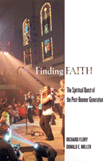 large Mall type mega churches that offer hundreds of programming choices to the religious consumer. The Resisters are those who are critical of postmodernism and resistant to any accommodation to current cultural changes and who keep a strong focus on rational faith and careful exegesis of the scriptures and ultimately desire to move young people back to a rational, text-based faith. Finally the Reclaimers are those evangelicals who are leaving evangelical churches in order to associate with strongly liturgical churches such as the Eastern Orthodox, Roman Catholic or Anglican. They are reclaiming the ancient traditions of worship of the early or Patristic church.
What do you think of these four types of response? Are there any responses that you might feel that they left out? Which response do you most identify with?
They build their analysis around 4 types of trends or styles that they see among evangelicalism: what they call Innovators, Appropriators, Resisters, and Reclaimers. The innovators are represented by people like Brian McLaren and Leonard Sweet, and, according to the authors, prefer smaller congregations with a high level of engagement with the larger community and social issues. The Appropriators are the
 large Mall type mega churches that offer hundreds of programming choices to the religious consumer. The Resisters are those who are critical of postmodernism and resistant to any accommodation to current cultural changes and who keep a strong focus on rational faith and careful exegesis of the scriptures and ultimately desire to move young people back to a rational, text-based faith. Finally the Reclaimers are those evangelicals who are leaving evangelical churches in order to associate with strongly liturgical churches such as the Eastern Orthodox, Roman Catholic or Anglican. They are reclaiming the ancient traditions of worship of the early or Patristic church.
What do you think of these four types of response? Are there any responses that you might feel that they left out? Which response do you most identify with?
Tuesday, August 4, 2009
"Searching" and "Seeking"
Search engines, bots, apps, information... information overload. Is there an app for seeking God? We go a little nuts if we can't get google to display what we're really looking for... ever seeking but never coming to a knowledge of the truth. How do search technologies shape the way we think about, or don't think about, seeking God? How can digital technologies help us seek and find God, and how can they get in the way? With so many access points into our lives--cell phones, social networks, pings and pokes, and on and on--how do we create time and space for God to find us, and us to find him?
Monday, July 27, 2009
SIGNS OF CESSATION
New topic. This below is taken from Charles Simpson’s June 2009 letter. You can find it online at http://www.csmpublishing.com/pastoral.php.
SIGNS OF CESSATION
When the Holy Spirit begins to lift the intensity of revival, our own misunderstanding of what He is doing can lead to burn out, disappointment, and burned over fields. How do we know that the Lord is saying the revival season is over? Here are some signs:
-Real Revival usually comes suddenly in power and spontaneity. When that electric sense of spontaneity ceases or subsides and attendance at special gatherings declines, it’s over.
-Real Revival brings dramatic testimonies. When testimonies are more forced and less significant, it’s over.
-When leaders have to work harder to get a response, it’s over.
-When leaders try to export or duplicate the experience, it is probably over.
-When leaders fail to exercise discernment and allow obvious moral problems, excessive displays, or unbiblical error, it will soon be over.
Wednesday, July 15, 2009
Mixing Metaphors
As we think about this entity we call "church," we have several metaphors operating in our minds and imaginations. We begin with Scripture: church as body of Christ, as people of God, as branches of the vine, as the living temple of the living God, etc. These are foundational; my purpose here is not to call them into question, but to ask if there are some additional, contemporary metaphors that might get us "seeing" in a different way, or from a different point of view. I'm particularly interested in missional metaphors (whatever you think that means!). So do some imagining, and then do some writing!
Tuesday, July 14, 2009
Reading list
ok, this thread still has a little life in it. John Meadows asked who recommended which books and who wrote the annotations. I got most of the annotations from reviews on amazon because only Laurel and Brian actually sent me annotations?
Here you go … do any of you lurkers want to add any book suggestions?
Brian Emmet:
Wright, N. T. Justification: God’s Plan and Paul’s Vision. Downers Grove, IL: IVP Academic, 2009.
David Bentley Hart, Atheist Delusions: The Christian Revolution and Its Fashionable Enemies (Yale UP, 2009)
Robert Grant
Finke, Roger, The Churching of America, 1776-2005; Winners and Losers in Our Religious Economy. New Brunswick, NJ: Rutgers University Press, 2005.
Tickle, Phyllis. The Great Emergence. Grand Rapids, MI: Baker Books, 2008.
Lencioni, Patrick. Death by Meeting: A Leadership Fable. About Solving the Most Painful Problem in Business. San Francisco: Jossey-Bass Books, 2004.
------. The Three Signs of a Miserable Job: A Fable for Managers (and Their Employees). San Francisco: Jossey-Bass Books, 2007.
Noll, Mark A. The New Shape of World Christianity: How American Experience Reflects Global Faith. Downers Grove, IL: Intervarsity, 2009.
Laurel Long
Durant, Will and Ariel. “The Reformation.” The Story of Civilization, Vol. VI. Great NecK, N.Y., 1935.
Hayek, Fredrick A. The Road to Serfdom. Edited by Bruce Caldwell. 2007. The University of Chicago Press, 1944.
Thursday, June 25, 2009
Traditional Pedagogy in peril?
Traditional Pedagogy in peril?
this is from Scot McKnight's blog today, Jesuscreed.org... regarding the future of universities as learning styles and the knowledge base are changing.
................
"Meanwhile on campus, there is fundamental challenge to the foundational modus operandi of the University -- the model of pedagogy. Specifically, there is a widening gap between the model of learning offered by many big universities and the natural way that young people who have grown up digital best learn.
The old-style lecture, with the professor standing at the podium in front of a large group of students, is still a fixture of university life on many campuses. It's a model that is teacher-focused, one-way, one-size-fits-all and the student is isolated in the learning process. Yet the students, who have grown up in an interactive digital world, learn differently. Schooled on Google and Wikipedia, they want to inquire, not rely on the professor for a detailed roadmap. They want an animated conversation, not a lecture. They want an interactive education, not a broadcast one that might have been perfectly fine for the Industrial Age, or even for boomers. These students are making new demands of universities, and if the universities try to ignore them, they will do so at their peril."
................
to me, the "The old-style lecture" and traditional pedagogy sound a little like a Protestant church service. In our weekly God-parties, I found it true that non-churched secular young people want "animated conversation, not a lecture."
so ... as we look at books like the "Great Emergence" and such themes as the collapse of the Evangelical church and possibly even the "great falling away" as young people abandon church services, what implications does the above information have for the task of reproducing the faith in a new generation?
PS: if you want to contribute some books to the summer reading list (annotated bibliography) please send them to me with a paragraph or two describing the book at josenmiami@yahoo.com
Monday, June 15, 2009
Summer Reading List
summer is almost here... tell us what you are planning to read this summer and why. If possible, rank your book selection by priority.
I~ll have to contribute my list after I arrive back in Miami on Wednesday.
ok Laurel: go! You too Biiilly....
I~ll have to contribute my list after I arrive back in Miami on Wednesday.
ok Laurel: go! You too Biiilly....
Sunday, June 7, 2009
500-Year Rummage Sale

Ok, lets try to rewind this conversation again and refocus using Phyllis Tickle’s book, The Great Emergence. I heard about this book from Robert Grant, and then saw a series of reviews on Scot Mcknight’s blog, I tried to be satisfied with following Mcknight’s reviews but finally had to break down and buy it. I thought it was an excellent book, although I was a little dissatisfied with the last chapter. She tried to indicate Calvary Chaple and Vineyard as “emerging” or postmodern churches, which I really don’t buy into.
Which of you have the book already? Has anyone already finished it?
Her basic thesis is that about once every 500 years, the church holds a rummage sale and reorients itself to whatever current cultural condition it finds itself in. She believes were are approaching one of those 500-year junctures and that the rummage sale has begun. This is similar to what others such as Bob Mumford have said.
What do you think? Shall we read the book together?
Subscribe to:
Posts (Atom)

